Unfortunately, most entrepreneurs don’t come out of the womb knowing how to build an effective marketing plan. It’s something I and my team see every day when working with small business owners. I have a hunch why, and I’d like to offer a simple solution to improve your marketing this year. It’s the Perfect Customer Lifecycle. Think of it as a marketing plan that marries simple with an eye-opening epiphany. We like to think it’s the framework every business owner and marketer of a growing company uses when thinking about their sales and marketing funnel for prospects and customers.
Limitless options causes overwhelm.
While some entrepreneurs are confident students of marketing, most report a feeling of overwhelm and uncertainty about what they should include in their marketing plan. The “menu” of available marketing tactics that I could do is ever growing.
- E-mail marketing—How can I be using it better?
- Social media—How do I interact with my fans?
- Website—How do I make it more effective?
Incomplete plan leads to shut down.
At first, it’s exciting to think of all of the possibilities and tactics, but it soon feels more like chaos than strategy. When all of these mini-strategies don’t roll up to a comprehensive marketing plan, the end result is too often overwhelm and helplessness (i.e. We shut down and don’t actually do much of anything).
How this year can be different.
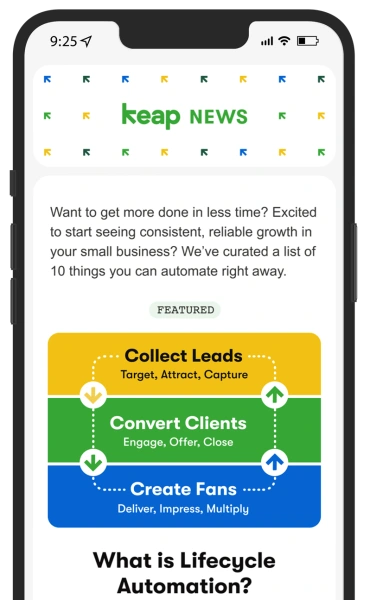
We created the Perfect Customer Lifecycle because we wanted you to have a free, simple guide that helps you take your marketing to a new level this year, and next. The Perfect Customer Lifecycle was redesigned from the feedback we received on our Success Path. The Perfect Customer Lifecycle is a comprehensive framework that works for all business types.
First, it started out with this whiteboard sketch.
We thought about it much more and made tweaks to create more clarity.

And then our awesome marketing team got their hands on it to create the Perfect Customer Lifecycle in its final form. I’ll explain each step now.

There are seven distinct phases to the Perfect Customer Lifecycle:
- Attract Traffic
This includes all of the work you do to generate interest in your business, like website traffic, foot traffic, etc. that comes from online/offline advertising, partners, etc. - Capture Leads
Smart businesses are very intentional about capturing contact information for interested leads as well as permission to follow up. You can’t follow up if they leave your site or store without giving you their info! - Nurture Prospects
Let’s face it, some leads are hot, and some are not. Smart businesses have appropriate follow-up in place to educate & build trust with their new leads. Some take 5 minutes to warm up, some take five weeks, some take five years, but when you nurture well, you are the one they think about when they are ready to buy. - Convert Sales
Once prospects are hot, it’s time to turn them into customers. Whether you have a sales team, or you use automatic follow-up to get the job done, you’ve got to close the business. - Deliver & Satisfy
What are you doing to make sure that every new customer is completely wowed by you? In addition to delivering your core service, there are many small but powerful strategies for creating happy customers - Upsell Customers
We all know that it is significantly cheaper to resell a new product to an existing customer, but too often we aren’t systematic enough about offering additional products to customers who’ve already bought. - Get Referrals
Finally, there are never any better leads than those who come from referrals. What are you doing to ensure that your customers are referring you when they get asked the questions.
The key takeaway to think about is, “How does it fit in your business?” How can you benefit from incorporating this thinking into the way you operate your marketing and sales functions of the business? As I’ve watched business owners use this Perfect Customer Lifecycle guide to map out their marketing plans (many of whom actually stick it up on their wall in front of their desk as a constant reminder) here’s what I’ve observed:
- Chaos turns to order—Everything you are doing finally has a place.
- Goals become clear—Rather than doing stuff just to do it, each marketing activity has a distinct purpose.
- Gaps become clear—Now that the comprehensive plan is staring at you in the face, it’s simple to identify additional opportunities that you can jump on.
- Structure breeds innovation—Although counter-intuitive, the structure and focus you provide yourself while planning will free your mind up to powerful innovation.
- Printing and posting helps you execute—Those who print their one-sheet marketing plan and tape it to the wall where everyone can see it find that their ability to execute on the plan increases.
I’m excited to dig deeper on this and share best practices for each phase of the lifecycle. If you want to know more about the Perfect Customer Lifecycle, leave a comment with what you’d specifically like help with and what intrigues you the most about it.


Pingback: 2 Ways to Strengthen Relationships with Email
Pingback: Fill Your Sales Pipeline with Lead Generation Ideas
Pingback: Fill Your Sales Pipeline with Lead Generation Ideas – An Overview | Automatic Methods
Pingback: Geoffrey Moore’s Four Gears Model for Spinning a Viral Following